Blaming the British for the destruction helped persuade some wavering colonists to back the fight for independence. But the source of the inferno was not what it seemed
By Andrew Lawler
November 2025
The first morning of 1776 dawned mercifully warm and clear over Virginia’s port of Norfolk, a welcome change after the snow and bitter cold of December. It should have been a fine day for visiting neighbors to exchange gifts and share terrapin stew, apple toddy or the rum-spiked, heated punch called wassail.
On this morning, however, the townspeople were gripped with anxiety. Thousands of them, seeking protection, were crammed alongside a few hundred loyalists and British redcoats aboard a motley fleet of a hundred or so vessels that clustered in the harbor, including four British Royal Navy warships bristling with cannons. Only 100 yards or so away, rifle-carrying rebel sentries stood along the wharves lining the riverfront, part of a 1,500-strong force of patriot soldiers.
The two sides were locked in a fragile stalemate. The previous spring, the colony’s patriots, led by George Washington, Patrick Henry and other members of the planter gentry, voted to create a militia. By summer, Virginia’s royal governor—the Scottish earl John Murray, known as Lord Dunmore—had abandoned Williamsburg, then the capital city, for a shipyard near Norfolk. By fall, he had assembled an eclectic army of redcoats, Scottish merchants and formerly enslaved Black men, who had recently been granted freedom in exchange for military service. After the patriots defeated his outnumbered forces on December 9, at the Battle of Great Bridge, the governor and his supporters sought the safety of the ships, essentially handing control of the colony’s premier port to the patriot army, led by North Carolina Colonel Robert Howe and Virginia Colonel William Woodford.
For two intense weeks, both sides warily eyed each other. Patriot snipers hidden in dockside warehouses began taking potshots at people on the ships’ exposed decks. Finally, at year’s end, a frustrated Dunmore ordered his officers to destroy the sniper posts. But first Captain Henry Bellew sent a warning ashore, so that “women, children and innocent persons might have time to remove out of danger.” By New Year’s morning, many of Norfolk’s remaining residents had fled. The patriot soldiers—known as shirtmen, for their long hunting shirts—stayed, parading up and down the wharves with coonskin caps on their hoisted guns and taunting the British and the loyalists with “every mark of insult,” reported one Royal Navy captain.
The answer came around 3 p.m. that afternoon, when a broadside from the 28-gun Liverpool raked the waterfront. “When at length the first heavy gun of the fleet broke the horrible suspense,” recalled one civilian eyewitness, “we all simultaneously started up with a sort of mournful cry or wail.”
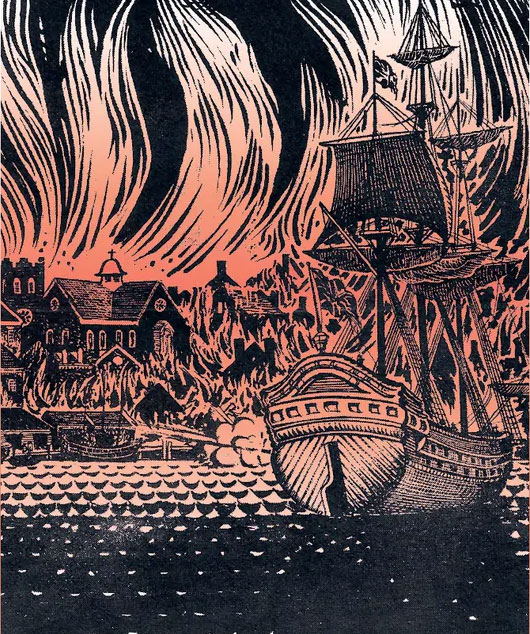
Within 15 minutes, artillery pieces on all four naval vessels were lobbing shells at the nearby shore. Several boats filled with British soldiers and armed Black loyalists then pushed off from the fleet, dense white smoke obscuring their passage to the town docks. By 4:30 p.m., several warehouses were ablaze. “What a glorious fight ensued!” exulted one British sailor.
The cannon barrage continued into the night. The distressed residents watching from the ships’ decks were relieved when the firing ceased and the city beyond the wharves emerged from the smoke largely intact. Then flames began to proliferate throughout the town and its suburbs. The sky turned a luminous ruby color, drawing the attention of a patriot officer stationed in the city of Hampton, more than a dozen miles to the northwest. The clouds, he wrote to his wife, “appeared as red and bright as they do in an evening at sun setting.” One local man recalled: “The horror of the night exceeds description and gives fresh occasion to lament the consequences of civil war.”
As the first day of 1776 ended, the thriving port city, home to nearly 6,500 people, was a roaring inferno. Within three days, most of Norfolk was a smoking ruin, and within five weeks not a single building was left standing. Lord Dunmore was blamed, and the brutal act of destruction helped convince many wavering colonists to back independence from Britain—still a radical notion at the time. Thomas Jefferson referred to the calamity in July’s Declaration of Independence, charging that George III had “burnt our towns, and destroyed the lives of our people.”
No American city before or since has suffered such complete destruction. Numerous history books and even Philadelphia’s Museum of the American Revolution maintain the story that Dunmore destroyed the entire town. There is, however, one problem with this dramatic claim about such a consequential Revolutionary episode: It isn’t true.
Colonial Norfolk was built along a 50-acre oblong peninsula on the north side of the Elizabeth River, moored like a leaky ship to the mainland by a slender isthmus and pierced with swampy creeks. Elegant brick townhomes and rickety wooden tenements shared narrow streets with grimy taverns. Smoky factories, teeming shanty-towns and tony new suburbs spilled north of the downtown. The city lay along a protected deep-water harbor that Dunmore deemed “as fine a one as any I ever saw.” A patriot officer wrote to George Washington that Norfolk was “the finest and most advantageous port in America.”
What had begun as a small regional port boomed in the 1760s, when entrepreneurs from distant Glasgow made it their hub and quickly gained control of the colony’s lucrative tobacco trade. These ambitious Scottish merchants plowed their immense profits into shipyards, ropewalks, leather works, flour mills and rum distilleries that soon lined the Elizabeth’s marshy banks. They built and operated private fleets and served as the colony’s bankers, lending money to the largely English-descended planters who were perpetually short of hard cash.
By 1775, Norfolk was the eighth-largest settlement in the 13 colonies, and the most populous between Philadelphia and Charleston, South Carolina. The bustling port boasted a cross-shaped brick Anglican church, a new powder magazine and North America’s first purpose-built Masonic hall. Stevedores trudged up and down piers that spiked into the river, ceaselessly hauling iron bars, tobacco hogsheads, rum casks, barrels of turpentine and loads of timber between waiting vessels and spacious warehouses. In the evenings, they rubbed shoulders with pirates and prostitutes in the many ramshackle pubs.
Public improvements, however, did not keep up with growth. “The sewage ditches are open, and one crosses them on little narrow bridges made of short lengths of planks nailed on cross pieces,” a visitor noted. These fetid waterways served as “receptacles of the filth of all the privies, and the nurseries of mosquitoes.” Another account warned that “putrid bilious fevers” and “verminous diseases” were common. To avoid the stink and pestilence, Scottish merchants built their mansions in the village of Portsmouth, across the river.
The dreadful conditions did not deter those seeking fortune or a measure of freedom. Norfolk served as a magnet for white artisans, sailors and tradesmen, as well as enslaved people who had escaped Virginia’s plantations. “Gone to Norfolk” was a phrase frequently found in newspaper ads placed by landowners looking for those who’d run away. Nearly half the town’s residents were held in bondage; the majority worked as domestic servants, in the factories or aboard merchant vessels.
A small but growing cadre of legally free Black residents also, against all odds, carved out a good living. Talbot Thompson was the rare enslaved person in Colonial Virginia who succeeded in purchasing himself and then obtained official manumission from the royal governor. Through his sailmaking business, he was able to claim at auction his longtime wife, Jane, who was also later manumitted. On the eve of the Revolution, they owned a spacious two-story home with a dairy and an orchard on a fashionable street.
Many of Virginia’s planter class were already inclined to look at Norfolk with suspicion before Dunmore sailed into its harbor in July 1775 with one small warship and made a nearby shipyard his headquarters. They also knew that, as in most Colonial ports at the time, many residents remained pro-British, although the mayor and several other leading officials were staunch patriots. The governor’s arrival sparked a rush by enslaved workers seeking sanctuary aboard the small fleet. The town’s pro-patriot newspaper noted that white residents were angered at “the elopement of their Negroes, owing to a mistaken notion which has unhappily spread amongst them, of finding shelter on board the men of war.” Because they were considered private property, granting them sanctuary was seen as tantamount to theft—and therefore further proof of British tyranny.
That same month, Joseph Harris, described in a Williamsburg newspaper as a “small mulatto man” and an accomplished ship’s pilot, escaped his Hampton patriot owner to join the king’s cause. His enslaver’s insistence that he be returned led to an argument with a Royal Navy captain that, in October, prompted the officer to attack the small port, the first battle south of Massachusetts. The deadly aim of patriot riflemen forced a hurried British retreat. “Lord Dunmore has commenced hostilities in Virginia,” Jefferson reported in a letter from Philadelphia to a friend in Britain. “It has raised our country into [a] perfect frenzy.” Both sides prepared for all-out war.
Patriot leaders now accused Norfolk residents of lackluster support for the glorious cause. Calls for the port’s destruction proliferated. Virginia patriot Richard Henry Lee wrote to Washington on October 22 that he hoped to hear soon of “the demolition of that infamous nest of Tories”—a term particularly applied to the Glasgow businessmen. Nine days later, at the bottom of a letter to John Page, the second in command on Virginia’s Committee of Safety, Jefferson wrote “Delenda est Norfolk”—Latin for “Norfolk must be destroyed,” a pointed reference to ancient Rome’s obliteration of its rival Carthage on the North African coast. “Like many in his class, Jefferson made the Scottish factors scapegoats for the planters’ economic troubles,” Alan Taylor, a University of Virginia historian, explains. Patriots also feared that the town would continue to attract people escaping enslavement. “This made Norfolk a potential cancer in the side of Virginia,” Taylor added.