More and more women of color are joining the 136-year-old organization.
By Andrew Lawler
April, 4, 2026
In 1976, Karen Batchelor was a young mother desperate for mental stimulation. One day, she went to a library in Detroit to explore her family’s history and unexpectedly found an Irish ancestor who had served as a Revolutionary War soldier on the Pennsylvania frontier. Batchelor, who is Black, was even more surprised when a librarian told her that this discovery qualified her for membership in Daughters of the American Revolution.
“All I knew about them”—the Daughters—“was what I learned at the dinner table,” Batchelor told me recently. DAR had long been known as a bastion of racism and elitism, and Batchelor’s parents, who were civil-rights activists, had shared a mostly negative view of it.
In 1939, the organization sparked national outrage when it barred the Black opera singer Marian Anderson from performing at its auditorium, Constitution Hall. Eleanor Roosevelt, then the first lady, publicly resigned from DAR in response, and a Protestant bishop labeled the society “the Mothers of Fascism.” Anderson subsequently performed on the steps of the Lincoln Memorial in front of an audience of 75,000; millions more listened on the radio. She was allowed to sing at a 1943 war-relief concert in Constitution Hall, but DAR’s overall ban on Black performers remained in place for another decade.
At the time when Batchelor learned that she was eligible to join the society, virtually all of DAR’s roughly 150,000 members were white. The group’s influence was in decline, and membership was flat. A writer for The New York Times dismissed the resolves made at its annual Continental Congress, which “no one really pays much attention to”—such as opposing arms control with the Soviet Union and warning that the Equal Rights Amendment would degrade women’s rights—as “laughably reactionary,” and damned with faint praise fundraising efforts to buy birdseed, plant trees, and save old buildings. Another writer noted that DAR’s aging members were known primarily for “outlandish hats, ill-fitting dresses,” and “stony faces.”
Batchelor’s mother had attended Anderson’s concert at the Lincoln Memorial, and her father had been seriously injured in Detroit’s bloody Belle Isle race riot. In the 1960s, at age 14, their daughter had been one of four Black students to integrate a white high school. She recalled sobbing from the loneliness as she came home from school one afternoon. “Why do I have to do it?” she’d asked her father. “Because somebody has to,” he replied.
Batchelor took his maxim seriously. In 1976, this meant contacting a local DAR chapter to explain that she was an African American woman with an ancestor who had fought in the war, and that she was interested in joining. She never heard back. A second chapter also failed to respond.
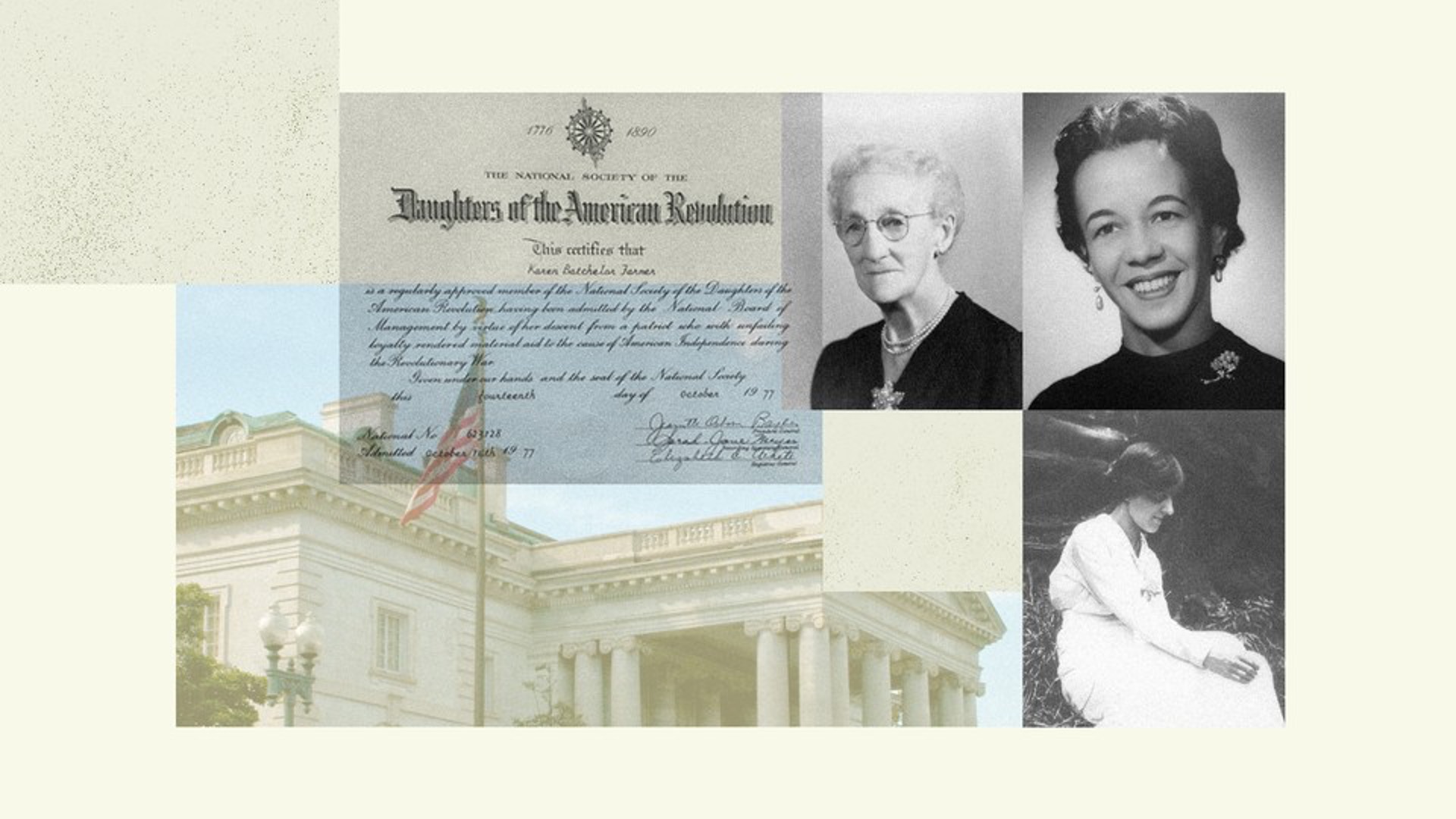
The librarian then contacted a friend at the National Archives who was part of a network of Black genealogists who felt that it was time for DAR to integrate. He helped Batchelor find a Detroit chapter willing to sponsor her application, and in 1977, she became the first openly Black DAR member since the turn of the 20th century. “I still have the framed certificate here on my kitchen wall,” Batchelor, now 75, said from her Detroit home. “Seeing it gives me resilience and strength.”
Although DAR does not officially collect data on its racial and ethnic makeup, a small but growing number of its members today are women of color. Shelley Murphy, a Black professional genealogist who joined DAR in 2013, considers herself part of a group that inadvertently launched a quiet revolution by applying to the organization in significant numbers during the Barack Obama years. They were able to do so thanks in part to advances in DNA testing and document digitization, and an active DAR-led effort to scour the historical record for Black and Indigenous Patriots (all members must prove direct descent from a Revolutionary War soldier or a supporter of the cause). These new members have in turn told sisters, friends, and cousins that the society now welcomes their presence, bringing more—and younger—women into the fold in the years leading up to the 250th anniversary of the nation’s independence. “I call it our infiltration,” Murphy told me with a laugh.
DAR, which was established in 1890 by four white women, never explicitly forbade Black women from joining. In its early years, the society aligned itself with progressive causes such as women’s suffrage—Susan B. Anthony was a longtime member—and even bestowed an award on a mixed-race member whose father had served in the Revolution. It also spawned local chapters that primarily sought to promote history education, preserve historic homes, and mark the graves of the Patriot dead. Members soon began to assemble an archive on Revolutionary War soldiers and early American families, which today is housed in a cavernous library at the group’s block-long headquarters across the street from the Ellipse, in Washington, D.C.