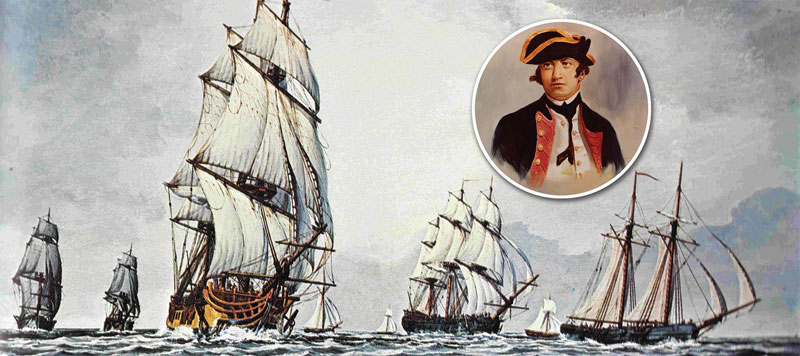
He served as the first commodore in what became the U.S. Navy. Yet, except for those who know their American naval history, Esek Hopkins is a name little remembered outside his home state of Rhode Island. For his inaugural mission at the start of that fateful year 1776, the Continental Congress ordered him to sail its first fleet to the Chesapeake Bay to crush a multiracial force threatening to stymie the patriot cause. The controversy that followed the expedition tarred Hopkins’ name, exposed bitter divisions between North and South, and made many skeptical of the Navy’s capacity to aid the Revolutionary War effort.
The clash between Britain and 13 of its North American colonies began in April 1775 on the green of Lexington and the fields around Concord. The Battle of Bunker Hill that followed in June also was purely a land operation. The patriots had no fleet to match the Royal Navy, considered the finest in the world in its day, which had stationed some 120 vessels in Boston Harbor in the wake of the famous Tea Party.
Rhode Island legislators, however, saw the need for developing American sea muscle. On 26 August 1775, two months after Bunker Hill, they told their delegates in Philadelphia to propose a plan for “building and equipping an American fleet as soon as possible,” one “with sufficient force for the protection of these colonies.” (See “Birth of a Navy,” October 2025, pp. 14–21.)
A Makeshift Fleet
George Washington, commander of the patriot forces camped in Cambridge just outside Boston, did not wait for Congress to act. On 2 September, desperate for supplies, he ordered a small fishing schooner called the Hannah “to take and seize all such vessels, laden with soldiers, arms, ammunition, or provisions” suspected of being in service to the British.
John Murray, the Fourth Earl of Dunmore, welcomed the formerly enslaved into his loyalist ranks in exchange for their freedom. His burgeoning Ethiopian Regiment struck fear into the heart of George Washington, who saw Dunmore as one of the greatest threats to a United States of America. Alamy
Three days later, the little armed vessel sailed from the Massachusetts port of Beverly under the command of Continental Army officer Nicholson Broughton, only to be chased by a British warship and forced to seek shelter in nearby Gloucester. On 7 September, the Hannah ventured out of Gloucester and captured HMS Unity, a small freight barge carrying salted fish, beef, and lumber, which the British had commandeered from a New Hampshire member of the Continental Congress. Pleased with that success, Washington had a half-dozen other small merchant ships fitted out as privateers in subsequent months, but these hardly made up a navy.
The Rhode Island proposal finally was presented in Philadelphia on 3 October 1775. New Englanders such as John Adams were strong advocates of the plan. Others, particularly Southerners, thought it too costly and even foolhardy, given the overwhelming strength of the Royal Navy.
Creating an American fleet was, Maryland’s Samuel Chase insisted, “the maddest idea in the world.” Opponents thought a fleet an expensive proposition designed solely to protect New England merchant interests. And at a time when independence was still not openly discussed, the creation of an independent navy was seen by many as needlessly provocative.
Word of Washington’s move to arm merchant vessels softened the stance of critics. In a compromise, the Philadelphia delegates encouraged individual colonies to outfit armed vessels while also setting up a Marine Committee dominated by New England naval advocates.
The Rogue Royal Governor
By then, a second threat to the patriot cause had emerged, this time 500 miles south of Boston. The royal governor of Virginia, Lord Dunmore, had fled the capital of Williamsburg in the summer of 1775 to set up a loyalist base at the shipyard of Gosport, upstream from the strategic port of Norfolk.
Though he was unable to attract much support from Boston or Britain, the resourceful Scottish earl used a few Royal Navy ships and vessels leased from sympathetic merchants to conduct raids on Virginia’s vulnerable plantations. These raids secured needed supplies while welcoming enslaved Africans eager to flee their patriot owners. With his expanding homegrown forces controlling much of the Chesapeake Bay, Dunmore intended to reassert Crown control over the largest, richest, and most important of the 13 colonies.
“Lord Dunmore has been many months committing hostilities versus Virginia, and has extended his piracies to Maryland,” complained Chase during a congressional debate on 6 October, three days after the Rhode Islanders had made their plea. He accused Virginians of inaction.
Richard Henry Lee, a member of that colony’s delegation, was put on the defensive. “Virginia is pierced in all parts with navigable waters,” he explained. “His Lordship knows all these waters, and the plantations on them.” The British had unquestioned naval superiority, and Lee shared intelligence that the Royal Navy in Boston was “coming to assist [Dunmore] in destroying these plantations,” since his influence was “sufficient to obtain what he pleases.” The result, he warned, could be “decisive destruction to Maryland and Virginia.”
The governor, in other words, posed a lethal threat to the patriot cause in two colonies that lay between the Carolinas and Pennsylvania. Their loss would spell disaster. “I wish Congress would advise Virginia and Maryland to raise a force by sea to destroy Lord Dunmore’s power,” Lee said.
Others argued that a more unified response was necessary, both to counter the royal governor and to obtain munitions necessary for patriot guns and cannons. On 13 October, the Continental Congress authorized two 10-gun vessels each crewed by 80 men to be readied within three months to seize “such transports as may be laden with warlike stores” and “for such other purposes as the Congress shall direct.”
At month’s end, a patriot land force repulsed a convoy of British tenders at the Battle of Hampton, not far from Norfolk, marking the first bloodshed south of Massachusetts. (See “First Shots in the South,” October 2025, pp. 28–33.) That victory boosted patriot morale, but it proved ephemeral.
The royal governor seized stocks of patriot munitions during the first half of November and extended his control over all of southeastern Virginia. On 15 November, he soundly beat a larger patriot force at Kemp’s Landing, which prompted him to publish an emancipation proclamation freeing those enslaved by patriots in exchange for their support for King George III. The trickle of people already fleeing to the safety of British lines turned into a flood. Dunmore quickly formed the Ethiopian Regiment to train and arm the new black recruits, just as a large patriot army began to march from Williamsburg to Norfolk.
Dunmore’s move to free and arm those enslaved shocked and terrified white patriots throughout the colonies. “If, my dear sir, that man is not crushed before spring, he will become the most formidable enemy America has,” Washington wrote Lee on hearing the news. “His strength will increase as a snowball by rolling; and faster, if some expedient cannot be hit upon to convince the slaves and servants of the impotency of his designs.”
The general warned that “nothing less than depriving him of life or liberty will secure peace to Virginia.” He later wrote an officer that “Lord Dunmore should be instantly crushed” before more black men flocked to his standard.
On 22 December, an alarmed Congress officially named Esek Hopkins as “commander in chief of the fleet of the United Colonies.” A Rhode Island merchant, he had previously served as captain of a slave ship during a particularly notorious voyage. When the brutal conditions on board the Sally led to an uprising among the human cargo, Hopkins and his crew shot and killed at least eight men; by the time the ship landed, more than half of the nearly 200 Africans had perished, including many by suicide.
Now the 57-year-old mariner was serving as a brigadier general for the colony’s militia. Patriot officer Colonel Henry Knox judged him an “antiquated” seaman who was “shrewd and sensible,” though partial to swearing. His appointment no doubt was linked to the fact that his brother was Stephen Hopkins, who sat on the Marine Committee. Stephen assured Esek that while the fleet was small, it was “but the beginning of one much larger.”
A Tall Order
Despite the threat posed by Dunmore, however, Congress was slow to issue orders for the infant Continental Navy, made up of merchant ships that required extensive modifications to make them ready for war. Hopkins’ flagship was the 440-ton Alfred, a commercial vessel built in Philadelphia in 1774 that lay anchored in the Delaware River. On 3 December, when its ownership passed to the Continental Congress, Lieutenant John Paul Jones raised the Grand Union flag above the deck of the 24-gun frigate—the first time the banner of the united colonies had been unfurled.
The crisis in Virginia, meanwhile, deepened. A patriot land force defeated Dunmore’s redcoats and Ethiopian Regiment troops at Great Bridge, outside Norfolk, forcing the thousands of loyalists to retreat to a makeshift flotilla in the harbor. On 1 January 1776, during a British raid to destroy enemy sniper nests along Norfolk’s waterfront, the patriot army burned the city to the ground and blamed the disaster on Dunmore. Five days later, after word of Norfolk’s loss reached Philadelphia, Congress finally issued Hopkins his orders.
The newly minted commodore was instructed to proceed “with the utmost diligence” to the Chesapeake Bay with a fleet of eight, including two small Maryland ships set to rendezvous with Hopkins to augment his firepower. Some viewed the mission as unfeasible, even foolish; the combined vessels were hardly a match for one Royal Navy warship, let alone the four then patrolling the Chesapeake. A Maryland patriot in Annapolis warned John Hancock, president of the Continental Congress, that given “the strength of Lord Dunmore,” it was “imprudent to hazard” an encounter with the British.
What the patriot fleet lacked in size, experience, and firepower, however, the Marine Committee hoped to make up for in speed and secrecy. “You will discern, gentlemen, that the greatest dispatch will be necessary,” the orders read, “the success of the stroke being more sure as it [may] be most sudden and unexpected.”
Hopkins was directed to sail out of the Delaware and into the Atlantic, steering south for Cape Henry at the mouth of the Chesapeake. There he would scan the sand dunes for a white flag waved by a sentinel, who would “furnish the commander in chief with the most accurate information of the then strength and situation of Lord Dunmore’s fleet and land forces.”
The next step was up to Hopkins. “If by such intelligence you find that they are not greatly superior to your own, you are immediately to enter the said bay, search out and attack, take, or destroy all the naval force of our enemies that you may find there,” his orders stated. He also was instructed to take on board 200 “expert riflemen . . . before [his ships] come in sight of the enemy.” Fast vessels bristling with the barrels of skilled snipers might not be able to sink a British frigate, but they could harry her and even force a surrender.
After completing that mission, Hopkins was to “proceed immediately to the southward and make yourself master of such forces as the enemy may have both in North and South Carolina.” There were already rumors of a planned British invasion of that area. Hopkins was, however, given leeway to “follow such courses as your best judgement shall suggest” in case of bad weather or other obstacles.
Members of the Marine Committee then sent a message to Virginia’s patriot leaders acknowledging “the peculiar distress” caused by Dunmore’s naval forces and promising that the Continental fleet would “seize and destroy as many of the enemies’ ships and vessels as they can.” The committee recognized that land troops were needed as well; Maryland was tasked with supplying minutemen companies, and Pennsylvania was asked to distribute half a ton of precious gunpowder. These combined forces were the patriots’ best hope to neutralize the governor and his loyalist allies. But gathering the necessary troops would take time.
Inauspicious Beginnings
It was late January before Hopkins finally departed Philadelphia on board the Alfred, accompanied by the Columbus, Andrew Doria (aka Andrea Doria), Cabot, Providence, and Fly. Flapping at the Alfred’s mainmast was what became known as the Gadsden flag, depicting a rattlesnake and the phrase “Don’t Tread on Me.” She also flew the Grand Union flag with 13 stripes.
Loyalist spies quickly relayed word of the patriot fleet’s departure to Samuel Graves, the British admiral in Boston. He dispatched the formidable 886-ton HMS Roebuck, with two decks, 44 cannon, and more than 200 crew, from Halifax in Canada to the Chesapeake Bay under the command of Captain Andrew Snape Hamond. This vessel was twice the size of the Alfred and far more heavily armed. After neutralizing Hopkins, Hamond was to proceed to Delaware Bay to blockade Philadelphia.
Unknown to the British, Hopkins’ ships had quickly become trapped in the winter ice choking Delaware Bay and remained stuck for more than a month. Adverse winds, desertion, and illness further hampered the situation. The dreaded and often deadly disease of smallpox, then ravaging New England, had made its way on board four of the ships, leaving many too sick to accomplish their tasks.
The two Maryland vessels, the Hornet and Wasp, appeared in the bay on 15 February as the ice floes broke up. Two days later, the convoy lifted anchor and made its way past Cape Henlopen, at the southern tip of Delaware Bay, as a bitter northeast wind blew. Once in the Atlantic, the commodore decided to bypass the Chesapeake altogether. “I did not think we were in a condition to keep on a cold coast,” he later explained to John Hancock. Instead, he set course for Abaco Island in the warmer climes of the Bahamas.
Once the fleet reassembled there two weeks later, Hopkins ordered an assault on Nassau, the main British port of the island chain. On 3 March, 200 Marines and 50 sailors quickly overran the town’s small fort “without any opposition.” The successful attack marked the first landing of what would become the U.S. Marine Corps. (See “The First Marine, December 2025, pp. 14–21.) Once the governor had turned the fort keys over to Hopkins, the patriots loaded their ships with “several warlike stores,” including 38 barrels of gunpowder vital for the fight against Britain.
Unfortunately for the Americans, the governor had been warned of their arrival and had sent 162 barrels of the precious munition to Florida’s St. Augustine, then under British control, for safekeeping. It was, nevertheless, an important strategic win, since it exposed British weakness in the Caribbean, forcing the Royal Navy to divert ships from the American colonies.
A Brush with the British
After two weeks occupying Nassau, the fleet set sail for New England. On 4 April, as they passed New York’s Long Island, the American vessels seized a British schooner with cannon, swivel guns, “and all sorts of stores, arms, powder, etc.” But their luck ran out two days later, when the flagship and the Cabot encountered HMS Glasgow, a sixth-rate frigate carrying 20 guns.
Hopkins was at a disadvantage in crew, experience, and sobriety. Many of his men were distributed among three British ships captured by the commodore, while “some that were onboard had got too much liquor out of the prizes to be fit for duty.”
The Glasgow engaged Hopkins’ fleet in a fierce three-hour battle, killing four men on board the Cabot when the brig drew “within pistol shot.” That vessel’s captain—Hopkins’ son—was among seven injured. Hopkins reported that “we received considerable damage to our ship,” which allowed the enemy to escape. “I did not think proper to follow,” he added, lest he put the valuable captured armaments and munitions at risk. One officer who particularly distinguished himself in the fighting was John Paul Jones, who won promotion to captain.
The fleet anchored off New London, Connecticut, on 8 April. An elated Washington arrived the next day and boarded the Alfred to congratulate and confer with Hopkins. While he had not tangled with Dunmore, the commodore had obtained vital war supplies and showed American mettle. The general granted Hopkins’ request for 200 additional men to serve as crew for an attack on a British fleet in nearby Newport. In the end, the British sailed away before Hopkins arrived, and Washington, pressed for troops, requested their return to bolster defenses in New York.
By then, the British had abandoned Boston, but Dunmore’s flotilla was still wreaking havoc in the Chesapeake Bay, and the British invasion of the Carolinas was imminent. The Marine Committee urged the fleet to set sail for the South. “I am afraid [I] can’t get away for want of men,” Hopkins wrote Washington on 22 May. Many were sick while new ones were difficult to come by. “It will be with great difficulty the fleet here can be manned.” John Adams confirmed in a 4 June letter to Richard Henry Lee that “a dreadful sickness has raged among his men and disabled him from putting more than two of his vessels to sea.”
Actions Under Scrutiny
The same day Hopkins made his complaint to Washington, the frustrated Marine Committee set up a panel to review whether the commodore had willfully ignored his original orders. While many New Englanders hailed Hopkins as a hero, Southern members of the Continental Congress as well as some from the middle colonies were infuriated by his failure to take on Dunmore or protect the Carolina coasts.
In a stinging 15 June letter to Washington, Hancock lambasted “the shameful inactivity of our fleet for some time past” and “the frequent neglect or disobedience of orders in Commodore Hopkins.” He cited “the numberless complaints exhibited to the Marine Committee against him” and two other fleet officers. All three were summoned to Philadelphia “to answer for their conduct” and put “our ships on a more respectable footing.”
On 12 August, Hopkins appeared before the Marine Committee. “I had a very laborious task, against all the prejudices of the gentlemen from the southern and middle states, and of many from New England,” Adams wrote that day in his diary. “I thought, however, that Hopkins had done great service and made an important beginning of naval operations.” He decried “that anti–New England spirit which haunted Congress” and praised Hopkins’ conduct. According to notes made by Thomas Jefferson that day, Hopkins insisted his orders allowed him to change his mission according to his discretion. “If he was mistaken, then it was no crime,” Jefferson reported the commodore as saying.
Jefferson, however, argued that “the commodore had a premeditated design not to go to the southern colonies but to Providence” and did not seek fresh intelligence at the Chesapeake cape as ordered. Hopkins clearly had not tried to ascertain Dunmore’s strength, Jefferson said. In addition, he had failed to stop in the South on his return from the Bahamas to provide patriots there with weapons and munitions. The commodore’s encounter with the Glasgow “shews he wanted skill and activity,” Jefferson wrote.
To his critics, Hopkins “did not exercise an honest discretion in departing from his instructions” and, in fact, “never did intend to obey them.” Subsequently, they noted, the commodore focused exclusively on protecting New England merchants. South Carolina’s Edward Rutledge called Hopkins “totally unfit” and dismissed his defense as “trifling to the last degree.”
After a heated debate, the delegations of six states on 16 August found “the conduct of Commodore Hopkins deserves the censure of this house.” Three opposed the move, while three more could not reach a verdict. Hopkins was allowed to resume his command, though a dark cloud hung over his name. Even his former first lieutenant, John Paul Jones, turned against him.
In late 1777, Jones accused Hopkins of blocking his appointment to command a Caribbean squadron out of jealousy, though the commodore claimed he lacked the necessary vessels. A few weeks later, on 2 January 1778, Congress voted to relieve Hopkins of his command because of additional neglect and insubordination. Many members felt neither Hopkins nor the fleet had lived up to the promises made by advocates such as Adams. Jefferson later concluded the nation should restrict itself to small gunboats and “avoid the ruinous folly of a navy.”
The aging seaman returned to his home state, where he served as a respected legislator well into the 1780s. But his national ignominy continued to sting. In the late 1790s, Adams stayed at a Providence inn and reunited with Hopkins, observing how “the old gentleman hobbled [in] on his crutches.” Hopkins was “at four score years of age, one half of him dead in consequence of a paralytic stroke.” The man Adams had defended expressed his gratitude “with his eyes overflowing with tears.” The nation’s first commodore died soon after, in 1802.
Nearly a century passed before his first and only memorial was raised on a Providence square. In the 20th century, two U.S. Navy destroyers and a patrol boat bore his name, as did a Rhode Island middle school. But in recent decades, his long-ignored role as a brutal slave trader has made him the subject of yet another controversy; in 2020, Hopkins’ name was removed from the school, in which one in five students are black. His statue, arm boldly pointing to sea, remains.
Today, some hail Hopkins as a brave naval hero unfairly brought down by bickering politicians. Others, including naval historian William M. Fowler Jr., conclude he was ineffective as an officer and insensitive to the politics of his day. What is beyond dispute is that the commodore who assisted in the birth of the U.S. Navy remains an ambiguous figure, embodying many of the tensions and contradictions that came with creating the new nation.
Sources:
Benjamin Duerksen, “Perceptions of Duty and Motivations for Service of American Seagoing Officers During the American Revolution” (master’s thesis, Texas A&M University, 2012).
Edward Field, Esek Hopkins: Commander-In-Chief of the Continental Navy During the American Revolution, 1775 to 1778 (Providence, RI: Preston & Rounds, 1898).
Esek Hopkins, The Letter Book of Esek Hopkins, Commander-In-Chief of the United States Navy, 1775–1777 (London: Forgotten Books, 2018).
Andrew Lawler, A Perfect Frenzy: A Royal Governor, His Black Allies, and the Crisis That Spurred the American Revolution (New York: Atlantic Monthly Press, 2025).
William Bell Clark, ed., Naval Documents of the American Revolution, vol. 3, American Theatre: Dec. 8, 1775–Dec. 31, 1775, European Theatre: Nov. 1, 1775–Jan. 31, 1776, American Theatre: Jan. 1, 1776–Feb. 18, 1776, history.navy.mil/research/publications/publications-by-subject/naval-documents-of-the-american-revolution.html.
United States Continental Congress, Journals of the American Congress: From 1774–1788; In Four Volumes (Washington, DC: Way and Gideon, 1823).